

Soul Care for Lawyers: Creation, Covenant, and Cross
In Soul Care for Lawyers: Creation Covenant and Cross, David McIlroy writes a reflection for lawyers to prepare themselves for Good Friday.
Our blog offers short, accessible, reflections on important and urgent issues for Christian lawyers, and anyone else involved in law. Here you’ll find quick, stimulating reads created to help and encourage you as you practise your legal vocation – and, indeed, as you live all of life – as a follower of Christ.

In Soul Care for Lawyers: Creation Covenant and Cross, David McIlroy writes a reflection for lawyers to prepare themselves for Good Friday.

In this blog post, David McIlroy argues that human rights theory, while pursuing laudable goals, is undermined by a possessive and individualistic conception of rights, and proposes that it can be reformed by reconceiving rights as relational, prioritising responsibilities over rights, and renewing deliberation about the common good.

Drawing on Tolkien’s suspicion of the concept of the “State” and Jesus’s famous response to the Pharisees and Herodians about paying taxes to Caesar, David McIlroy argues that Christian faith grounds a political freedom that demands neither blind obedience nor wholesale rejection of government, but a loyal, critical service oriented toward justice.

In this first instalment in our Human Rights Series, David McIlroy introduces the series as a whole and succinctly answers the question, “Why human rights?”

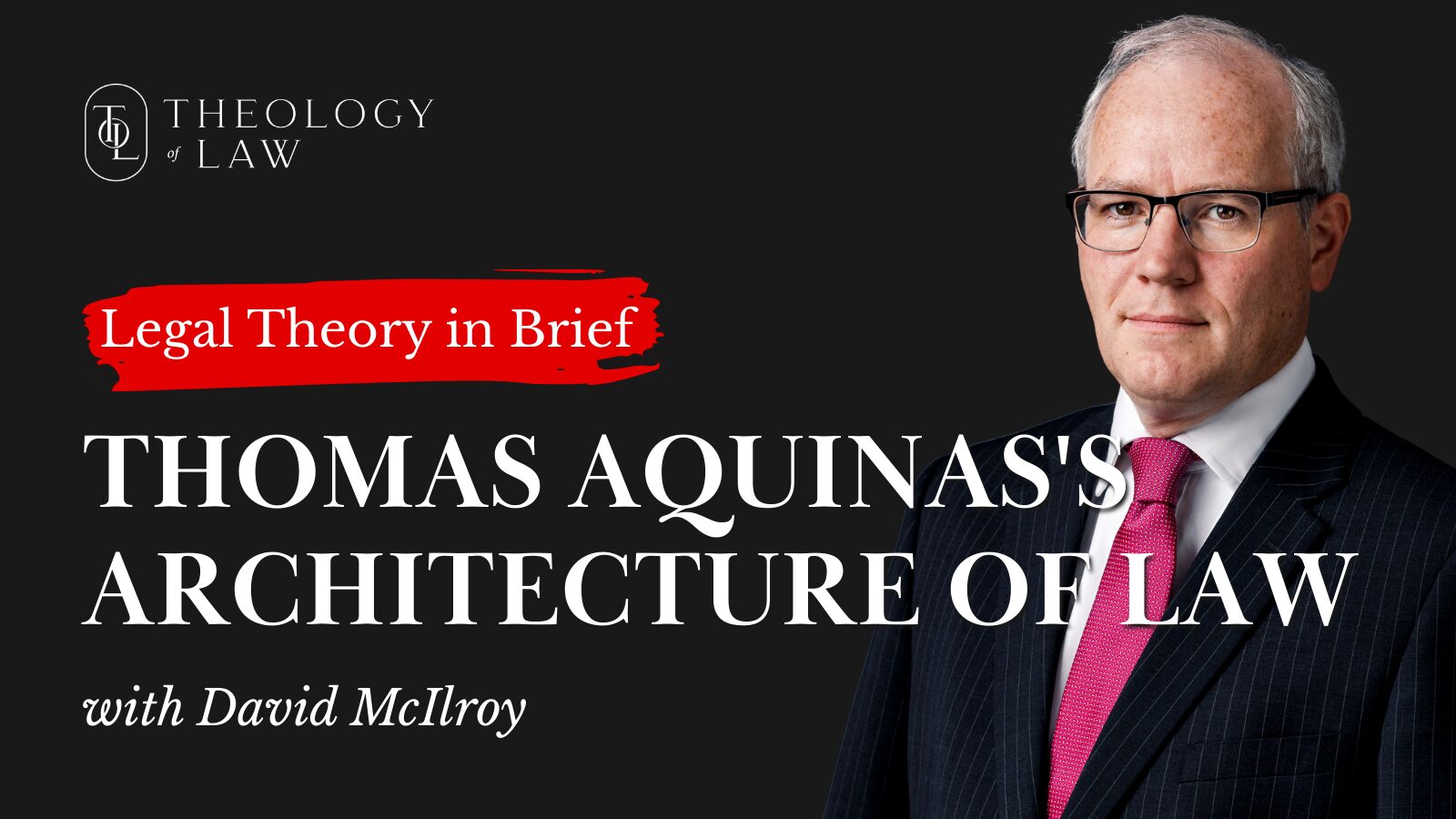
Thomas Aquinas developed a comprehensive framework dividing law into four types—eternal, natural, divine, and human—to show how God works through all things, despite human sinfulness, to achieve his purposes for humanity.

David McIlroy explores Thomas Aquinas’s systematic framework of natural law, examining how the medieval philosopher believed moral principles are known through reason and natural human inclinations at three distinct levels.

David McIlroy examines how legal positivism—the approach to law that focuses on whether legislation comes from the right source rather than its moral content—has roots in thinkers like Hobbes, Bentham, Austin and Hart, and explores Amanda Perreau-Saussine’s argument that all consistent legal positivists ultimately reject any philosophical notion of moral authority.

This sixth post in our Legal Theory in Brief Series explores the famous Hart–Fuller debate over whether law possesses an “inner morality,” contrasting Hart’s claim that even immoral regimes can create valid law with Fuller’s argument that true law requires adherence to moral procedural principles that enable human agency and justice.

In this fifth post in our Legal in Brief Series, David McIlroy explores and contrasts H.LA. Hart’s notion of Rules with Wesley Hohfeld’s notion of Rights and their implications for law.

In this fourth post and video in the series, David McIlroy explores John Locke’s conception of Rights and Authority, and shows how they have shaped our idea of rights and authority in modern society.

In this third post in our series, Legal Theory in Brief, David McIlroy examines the different meanings and defining features of law, contrasting checklist and central case approaches to understanding what truly makes a rule a “law.”
You’ll receive a monthly email with new resources, updates, event information and other curated content to help you live a life where the faith you profess and the law you practice are integrally connected. (Do note: We too hate spam and take your privacy extremely seriously. See our Privacy Policy to understand how we use and protect your data ).
If you want to know anything more about the materials on this website, to book David McIlroy to speak, or you’ve got any other question, please fill out the form here and we shall get back to you speedily.